↓
 

Historic South Dade

The past is never dead. It’s not even past. - William Faulkner

  • Home
  • Articles
  • Books
    • Detroit, Florida, in 1911
    • Lest We Forget
    • Wilderness on the Edge
  • Contact
  • Historic Homestead Newspapers
  • Index to Articles
    • Cutler
    • Detroit – Florida City
    • Goulds
    • Homestead
    • Longview
    • Modello
    • Naranja and Princeton
    • Redland
    • Settlement of South Dade
  • Resources
    • Automobile Owners in 1923
    • Census Spreadsheets
      • Agricultural Labor Resources
    • Directories
      • Business Directories
      • Telephone Directories
    • Dr. John B. Tower’s Birth Records
    • Finding Aid for Isabelle B. Krome Papers
    • Maps
    • Naranja Cemetery
      • Cemetery Index
      • Obituary Index
      • Section & Plot Maps
    • Research Aids for Homestead Claims
    • School Yearbooks
    • South Dade High School Integration
    • State Archive Resources
    • Town and City of Homestead Council Minutes, 1913-1965
Home - Page 6 << 1 2 … 4 5 6 7 8 … 19 20 >>

Post navigation

← Older posts
Newer posts →

Detroit Before Edward Stiling – Part II

Historic South Dade Posted on July 5, 2020 by JeffNovember 20, 2023

In Part I of this article, I provided some of the history of the area that became Detroit before 1910. As can be seen on the relevant portion of the F.E.C. Railway map below, the Model Land Co. owned most of the land in sections 24 and 25 of township 57 south, range 38 east. Its holdings are shown with diagonal lines:

Detroit

To make this clearer, here is a drawing that shows the holdings of the Model Land Co. in Detroit in light blue with the Brooker and Caves homestead claims in the west halves of sections 24 and 25 also shown:

Sections 24 25 Color

Henry Brooker, who had been in Miami as early as May of 1905,1 was hired by the F.E.C. to help build the telegraph line from Miami to Key Vaca. That line was completed on October 26, 1907.2

Henry Brooker and Jesse Scott Caves filed for homestead claims in the west halves of the northwest quarter of section 25 and the southwest quarter of section 24 of Township 57 South, Range 38 East. The balance of sections 24 and 25 (see diagram above), with the exception of the land claimed by Horace K. Roberts (the north half of the northeast quarter of 24), was owned by the Model Land Co. and was purchased by the Tatum Bros. Real Estate and Development Co. in May of 1910.3

Brooker Homestead

The drawing above shows Jesse S. Caves’ claim in the southwest quarter of 24-57-38 (top) and Henry Brooker’s claim in the northwest quarter of 25-57-38 (bottom).

The Model Land Co., following the scheme used in the federal township-range system, subdivided their lands into parcels which started at the northeast corner of each quarter-section and proceeded to the southeast corner of the section in 10-acre blocks instead of the 640 acre blocks used by the federal government:

Model Land Co

Jean Taylor, in her book The Villages of South Dade, wrote that William H. Hunter purchased a ten-acre plot of land and built a house in 1908 “at what later became the corner of S.E. 5th Avenue and S.E. 5th St. in Florida City.” A close study of the abstract of title for the Hunter property shows that Taylor was incorrect. The Hunter property was just outside the eastern boundary of what would become the Town of Detroit in 1910. On the portion of the plat for the Town of Florida City below, the Hunter property was adjacent to Blocks 42 and 43. Portions of it are now part of the Gateway mobile home park. In 1931, Mary E. Scott, Hunter’s widow, sold a strip of land 70′ wide so that Avenue B (now SW 3rd Ave.) could be extended.4

The plat of the Town of Detroit was recorded on November 19, 1913, about 5 years after Mr. Hunter purchased his land from the Model Land Co.

Screenshot 2023 11 20 at 10 09 10 PM

Plat of the Town of Detroit

Taylor wrote that Hunter’s grove on his 10-acre plot of land was a failure but that he “was successful in growing tomatoes on the railroad land.”5 Hunter grew truck crops on 5 acres of marl land east of the depot in Homestead in 1908-1909, along with A. T. Duval (15 acres), W. D. Horne (2 acres), T. A. Campbell (2 acres), Henry Brooker (10 acres), Leonard Mowry (10 acres) and Barney Waldin (5 acres).6

He also farmed “south of Homestead”7 during that season but the specific location was not noted. It is highly unlikely that Hunter either built a house, grew truck crops or planted a grove on that 10-acre parcel that early. It flooded in the summer and there was no way, short of flagging down a train, to get his crops to market and no easy way to get equipment and supplies to the land.

On June 9, 1909, Hunter’s daughter, Ida, was married to Thomas F. Cochran of Miami at her father’s home in Homestead.8

Homestead claims west of what was to become Detroit were filed as early as 1905 and by 1909, there were 10 claims on both sides of the future Palm Drive west of the Model Land Co. property that became Detroit.

In February of 1910, Henry Brooker and William Hunter filed a report with the Dade County Commission that laid out the route of a public road from Homestead to Detroit. It ran from the south end of Homestead Avenue, one block east of Railroad Avenue, crossed the railroad at an unstated point,9 and ran between the railroad and the Everglades across the Long Prairie, between Homestead and Detroit. When it reached the section line that is now Palm Drive, it ran west to the Camp Jackson Road near S.W. 197 Avenue.10 This rough road opened up the country for the existing homesteaders and made it accessible to a large number of new homesteaders who filed claims in 1910 and later.

On September 15, 1910, the Homestead correspondent for the Miami Morning News-Record reported that “Harry Hunter, eldest son of Mr. W. H. Hunter of Homestead and his bride, formerly Miss Clara Bates, daughter of T. J. Bates of Miami,” had gotten off the train in Homestead and “were bound for the home of the groom’s parents, where a bountiful dinner awaited them.”11 Shortly after this time, Hunter moved to his new house in the settlement of Detroit, for on November 15, 1910, he told a reporter for the Miami Metropolis that he lived there and stated that there were “over one hundred citizens there now … and that within a few months, three hundred will make their home there.”12
While Hunter was claiming credit for being the first resident and also stating that there were more people living there than the 30 pioneers that Edward Stiling had brought on October 28, 1910, another man, Joseph L. “Lafe” Ishmael, had actually built a house there. In a letter dated December 24, 1910 to his home-town newspaper in Arkansas City, Kansas, Ishmael wrote:

“We were the first family in Detroit. We came August 18. I began to build September 15. Now there are 200 people here. There are eighteen small houses and about twenty tents. There are two grocery stores, one is in a tent. A hotel is going up and there is a contract for a packing house 40 x 100. There is a sawmill on the town site. We have a nice little house two nice porches, 10 x 28. We hold church services and Sunday school on our front porch and will until there is a church built. We are raising money now to build one.”13

Since Lafe made a point of mentioning that his was the first family in Detroit, it appears that other later arrivals, including Hunter, were claiming to be first. Lafe’s contemporary letter, dated December 24, 1910, sought to disprove those claims.

Joseph L. “Lafe” Ishmael was born in October of 1856 in Montgomery County, Illinois. There, he married Nancy S. Ford in April of 1877 and started a family. By 1889, he had moved his family to Arkansas City, Kansas.14 Arkansas City was a commercial hub in southeastern Kansas, 60 miles south of Wichita and 100 miles north of Guthrie, Oklahoma. Lafe held a variety of jobs, apparently working for the Atchison, Topeka and Santa Fe Railroad in Guthrie, Oklahoma, briefly owning a grocery store in Arkansas City in 1890,15 being a policeman for Arkansas City for several years,16 being a janitor, the sexton of the City cemetery and then returning to being a grocer again in 1905, when he partnered with Tom Tyler to open a grocery store named Tyler & Ishmael.17 In March of 1906, he bought out his partner and continued to run the business by himself.18

Lafe divorced his first wife in the early 1900s and married his second wife, Mrs. Grace Yeakel Higgins, in Wichita on May 2, 1909.19 On May 21, 1910, he sold his grocery store in Arkansas City20 and on July 5, he and his new wife left for Detroit, Florida.21

A note in The Homestead Enterprise ten years later stated that “Mrs. Ishmael was the first white lady to come here in the original Detroit colony ten years ago.”22 By writing that Mrs. Ishmael was the “first white lady” in Detroit, the anonymous author for the newspaper was acknowledging that African-Americans lived there too.

By December of 1911, William Hunter was reported to be in poor health.23 He died on May 20, 1913 at his home in Miami.24 His widow, who had married James K. Scott, died in 1942 in Florida City but her son Herbert stayed there after marrying Lola Nixon, a niece of Lilburn R. Nixon. A son, Herbert Milton Hunter, was born to them in 1925. In the 1970s, he operated Milton’s Hair Salon in Homestead.

Lafe Ishmael worked for the Miami Land & Development Co. supervising the development of the drainage canal network in the East Glade and also as a carpenter who helped build Rev. Joseph A. Kahl’s house.25 He moved to Homestead before 1916, where his wife was a nurse and a friend of the Kromes.26 In June of 1918, the Ishmaels moved to Miami,27 where Lafe operated a grocery store.28 In later years, Lafe Ishmael ran a hotel in downtown Miami. He died in 1936 and is buried in Woodlawn Cemetery in Miami.

As is so common in history, those who stay get to tell the story. The Hunter family stayed in Florida City and Homestead and the Ishmaels moved to Miami, taking their story with them. For her entry on the Hunter family,29 Jean Taylor interviewed Ida Hunter Cochran Flowers and her mother, Lola Nixon Hunter. Their story did not include Lafe Ishmael, but he was the first resident of Detroit, not William Hunter.
_____________________________________________________________

Posted in Florida City, Florida East Coast Railway, Pioneers, Real Estate Speculation | 6 Replies

The Tatum Brothers

Historic South Dade Posted on May 25, 2020 by JeffAugust 28, 2023

By Jeff Blakley

Historians who have written about the Town of Detroit, the name of which was changed to Florida City in December of 1914, have noted that it was a planned community created by the Miami Land & Development Company. Briefly noted in those accounts is that the Miami Land & Development Co. was owned by the Tatum brothers from Miami, but nothing of substance has been written about them. In this article, I am going to provide some background on who the Tatums were and how they managed to become such prominent developers in early Miami.

There were four Tatum brothers in Miami: Judson Hugo (J. H. – 1859-1923), Bethel Blanton (B.B. – 1864-1943), Johnson Reed (J.R. – 1866-1938) and Smiley Mosteller (S.M. – 1870-1935).

These men were the children of the Reverend Aaron Sherriff (1834-1915) and Jane E. Tatum (1831-1909), who had seven children – six sons and one daughter. Aaron was originally from Ashe County, North Carolina but moved to Gilmer County, Georgia with his parents before 1850. He graduated from Penfield University, a Baptist school located 7 miles north of Greensboro in Green County, Georgia in 1855. 30 31 Rev. Tatum went on to “organize over two hundred churches and baptize over three thousand persons.”32

J H Tatum

Judson Hugo Tatum33 34

According to his obituary, Judson Hugo Tatum was born on July 16, 1860 in Cumming, Forsyth County, Georgia.35 However, according to the U. S. census for 1860, Judson H. Tatum, age 1, was enumerated in Gilmer County, Georgia, with his parents and older brother Bunyan.36 That means he was born in 1859, not in 1860. Little is known about Judson’s younger years, other than the fact that in 1870 he lived in Dawson County, the adjacent county to Gilmer to the southeast. In 1880, he was enumerated in Adairsville, Bartow County, a short distance to the west, where he was a school teacher. It is likely that the family moved often as his father preached at different churches.

The first mention of J. H. Tatum in a newspaper occurred in 1887, when The Weekly Floridian, in Tallahassee, reported that he had registered at the Hotel Leon.37 Judson was probably the first of the Tatum brothers to move to the Orlando area as he was the oldest. Phosphate was discovered in Bartow in 1881 and the town was incorporated in 1882.38 While documentary proof is lacking, it is probable that J. H. Tatum was one of the earliest men to get involved in the phosphate industry in the Bartow area. By 1890, J. H. Tatum had already established the J. H. Tatum & Co. real estate firm39 and was known as the “Duke of Bartow”40 and as “Phosphate Tatum.”41

Johnson R. Tatum, a younger brother of J. H., joined him in Bartow in late 1890, becoming the bookkeeper for his brother’s real estate company. He had come from Rome, Georgia, a town not far west of Adairsville.42 On February 20, 1891, J. H. and J. R. Tatum, with A. G. and R. J. Moore, formed the Moore & Tatum Phosphate Company with a capital stock of $25,000.43 In August of that year, J. H. went on a sales trip to the “hyperborean regions” and his brother, B. B., took care of marketing in Bartow.44 J. H.’s businesses were generating a lot of profit, apparently, as he and his brother also established the Bank of Bartow with a capital stock of $15,000 during this time. J. H. was president and B. B. was the cashier.45 In December of 1891, the Bank of Bartow and the Polk County National Bank merged and the Tatum brothers devoted their time to their “large mining and phosphate interests.”46 In March of the following year, J. H., J. R., W. K., and B. B. Tatum formed the Bartow and Plant City Railway Co., capitalized at $220,000, to build a railroad between Bartow and Plant City.47 In June of 1892, J. H. and B. B. Tatum purchased the Bank of Bartow and resumed their former positions at the bank.48 The railroad that the Tatums had proposed in 1892 was not built until 1895, however.49

J. H. Tatum & Co. was established in Bartow before 189050 and J. H. continued to run the company until at least the summer of 1900, when he was in Ocala trying to sell 20,000 acres of “fine turpentine land.”51 He then moved to the “gold region of northeast Georgia,” where he attempted to organize a mining company. That apparently did not work out so he decided to visit his brother B. B. in Miami, arriving there in late December of 1901.52 Deciding that Miami had better prospects than the gold fields of northeast Georgia, he arranged to assist Frederick S. Morse,53 a real estate agent who had been in Miami since the city had been founded. Morse and Samuel H. Richmond, of Cutler, were the land agents for the Model Land Co., the real estate subsidiary of the Florida East Coast Railway. In just a few months, J. H. re-established his company, J. H. Tatum & Co., with offices in the Belcher Block on Avenue D, and started selling real estate on his own.54 After his brother sold his interest in The Miami Metropolis in 1905, the two worked together on real estate development projects.

On August 5, 1906, J. H. married Miss Arideane Ault, who had come to Miami as a representative for the E. B. Douglas millinery firm earlier that year, on January 2.55 J. H. was 47 and his wife was 41 at the time of their marriage. They had no children.

Bethel B Tatum  from Florida East Coast

Bethel Blanton Tatum56

Bethel B. Tatum was born in Dawson County, Georgia on March 1, 1864. He spent his boyhood in Adairsville, Bartow County, Georgia, where he attended the public school. In 1881, he moved to Orlando, where he stayed a short time. He then moved to Kissimmee, where he worked as a mill hand and then moved to Bartow where, with one of his brothers, he operated a sawmill. In 1887, he started a career in the newspaper business when he purchased the Polk County, Florida Informant. He sold that paper a few months later57 and purchased the interest of G. M. Holden in the Advance-Courier.58 He published that paper for one year, re-purchased the Informant and merged the two papers to become the Courier-Informant.59

Bethel met his future wife, Mary Rebecca Forsyth, when she accompanied her elderly father to Bartow on a trip they hoped would improve his health. The Forsyths were from Rome, in Floyd County, Georgia, adjacent to Bartow County, where B. B. grew up. The relationship matured and B. B. and his wife were married on March 2, 1889 in Rome.60 B. B. sold the Courier-Informant and moved to Rome, where he became the owner and editor of the daily and weekly Herald. That was a short-lived venture, for by November of 1890, he returned to Bartow, where he joined his brother Judson H. in the real estate business.61 62 In 1892, he and his brother J. H. purchased the Bank of Bartow. B. B. was the cashier and his brother J. H. was the president. While he was the cashier of the bank, B. B. also served as the mayor of Bartow.63 In early 1894, a stock company was formed to purchase the Courier-Informant64 and B. B. assumed the editorship of the paper until he left for Miami, where he purchased an interest in the Miami Metropolis on December 29, 1899.65

The Miami Metropolis was established by Walter S. Graham and Wesley M. Featherly.66 Both were Republicans and, in an editorial published on December 29, 1899, after B. B. Tatum had purchased the paper, the former owners noted that the principal reason for the change in ownership was due to politics.67 B. B. Tatum was a Democrat, though the philosophy of the Democratic Party then was the opposite of what it is now. Tatum and the owners of the Miami Metropolis had been in negotiation for the sale of the paper since September 8, 1899 but B. B. did not arrive in Miami until after January 1, 1900 because of a quarantine Miami was under due to an outbreak of yellow fever.68 The Miami Metropolis became known as a “Flagler paper” under B. B.’s ownership. In 1905, he sold a half-interest in the paper to Simpson Bobo Dean, who was a brother of the wife of J. H. Hoskinson, a prominent attorney in Rome, Georgia. Hoskinson was a partner of Col. C. D. Forsyth, B. B.’s father-in-law.69 Under Dean, who had a contentious relationship with Flagler, the paper took a more critical stance towards the F.E.C.70 71 After Dean acquired a half-interest in the paper, B.B. left active management and worked with his brothers in real estate. Tatum sold his interest in the paper to A. J. Bendle on April 20, 1909.

B. B. Tatum’s first wife died on April 16, 1904 in Miami72 and he then married Mrs. Letah Marshall Davis, of Greenfield, Missouri. Letah was a descendant of Chief Justice Marshall73 and had two daughters by her first marriage. B. B. had no children by either wife.

J. R. Tatum

Johnson Reed Tatum74

Johnson Reed Tatum was born in Cumming, Forsyth County, Georgia on January 1, 1866. Like his brother B. B., he spent his boyhood years in Adairsville but then attended the public schools in Dalton, Whitfield County, Georgia. After graduating from high school, he “completed a commercial course of study in a business college in Louisville, Kentucky.”75

Johnson’s brothers, B. B. and J. H., had moved to Orlando in the early 1880s and his mother and father had followed them in January of 1886, when Rev. Tatum built a “very nice two-story cottage” on Pine Street in West Orlando.76 J. R. apparently moved to Orlando after graduating from the business college but then located in Rome, Georgia for a time. He returned to Bartow to join his brother J. H. in his real estate business as a bookkeeper in 1890.77 In 1891, he and his brother formed the Moore & Tatum Phosphate Company with a capital stock of $25,000.78 At the same time, he was working at the Bank of Bartow, owned by his brothers J. H. and B. B. In December of 1891, he accepted a position with the First National Bank of Tampa.79

On May 23, 1895, J. R. and Ada May McBride, of Greenfield, Missouri, were married by his father, the Rev. A. S. Tatum, at the Presbyterian Church in Bartow.80 At the time of his marriage, J. R. lived in Tampa.81 They had four children: Kay Benton, J. Ralph, William C. and Ada May.82 Ada’s father, William, was a clothing merchant in Greenfield. Letah Marshall Davis, the second wife of J. R.’s brother B. B., was also from Greenfield.

At some time in 1898, J. R. resigned his position at the First National Bank of Tampa and moved to Atlanta, where he was enumerated in the 1900 census as an “expert accountant.” He moved back to Tampa and “assumed his old position” after “recuperating in Georgia for the past two years.”83 In early 1903, he was promoted from bookkeeper to the position of paying teller, a more responsible position.84 In July, 1905, the Tampa Tribune reported that Letters Patent had been filed for the incorporation of the People’s Building and Loan Association of Tampa with a capital stock of $500,000. W. A. Varnadoe owned 150 shares and the balance of 315 shares, mostly in lots of 5 and 10, were held by fifty men, an unusual arrangement.85 J. R. didn’t stay with this business, instead electing to help found the City Savings Bank in 1906, with a capital stock of $50,000.86 In December of that year, he and J. M. Harvey, of the City Savings Bank, were among the organizers of the Central Realty Company, also capitalized at $50,000.87 In 1908, Harvey and Tatum partnered to build a new hotel, initially to be known as the St. Nicholas, but re-named the Marlborough when it opened in September. It was built at a cost of $40,000.88 Tatum established his own company, J. R. Tatum & Co., and became the agent for the People’s National Fire Insurance Company of Philadelphia, capitalized at $2,000,000, in late December of 1908.89

In early 1910, Tatum resigned from his position as cashier of the City Savings Bank to open a new bank in Ybor City.90 The new bank was the Bank of Tampa, capitalized at $100,000. J. L. Greer was president and J. R. Tatum was cashier.91 The Bank of Tampa collapsed in less than a year and was closed by the State Comptroller, A. C. Croom, who declared that it was “insolvent and incapable of continuing business” on January 15, 1911. It was alleged that J. R. Tatum “controlled the bank as his personal property, using the institution for his own purposes in lending money on doubtful security to various corporations in which he was interested, issuing false certificates of deposit and doing other things contrary to law, all for the purpose of personal gain, for the purpose of concealing the true situation and of misleading the public.”92 The fallout from the bank failure was covered by the local newspapers throughout 1911 and continued into 1912. In early 1912, Tatum left for El Boludo, Mexico, where he was involved in a mining operation.93 He returned to Tampa at some later date but his legal troubles continued through the middle of 1913, when he moved to Miami.94
Smiley M. Tatum

Smiley Mosteller Tatum95

Smiley Mosteller Tatum was born in Cumming in Forsyth County, Georgia on February 22, 187096 but the family moved shortly after he was born to the Black Militia District in Dawson County, a few miles to the south.97 He completed high school in Adairsville in Bartow County and then went to what is now Georgia Tech in Athens, Georgia, where he studied chemistry. He then joined his family in Bartow, where he worked as an analytical chemist until fumes from his work damaged his eyesight. He moved to Tampa and engaged in the real estate business until he moved to Miami in 1902, joining forces with his brother, J. H., who was already there.98

Blackman wrote that after Smiley Tatum completed his course in chemistry, he joined his family in Bartow, where he worked as an analytical chemist. His parents lived in Orlando, having moved there in 1886.99 His brothers J. H., B. B. and J. R. were in Bartow, half-way between Orlando and Tampa. It is likely that Smiley’s work as an analytical chemist was related to the phosphate industry, in which his brothers were heavily involved. After Smiley had to quit working as a chemist, he opened a laundry in Tampa, where he was said to be the “boss laundryman in this end of the State.”100 He still lived in Bartow, however. At the time of his marriage to Florence “Florrie” Blount of Bartow on March 11, 1900, he was engaged in truck farming and citrus growing on Terra Ceia Island, which is just north of Bradenton. In June of 1901, he was in Tampa, making arrangements to open a “large commission house.”101 In January of 1902, Smiley and his wife lived in Hyde Park, a neighborhood close to downtown Tampa.102 He also got into the patent medicine business, hawking Tatum’s Elektro Pain Kure, guaranteed to relieve neuralgia and cure most headaches.103 By the time he started marketing his headache cure, his brother J. H. had established himself in Miami and Smiley decided to join him, moving there to live with him in July.104

Bethel Blanton Tatum had been the first of the Tatum brothers to move to Miami, in January of 1900. His brother Judson H. followed him in January of 1902 and Smiley joined them shortly thereafter. Johnson R. Tatum did not arrive until mid-1913, so he was not involved in the founding of the Tatum real estate dynasty. Due to B. B.’s ownership of the Miami Metropolis and his social connections, along with his brother Judson’s experience in selling real estate, they had an advantage over many of the other men and women selling real estate at that time. Even though Johnson R. remained in Tampa, it is very likely that he advised his brothers on financial matters. The Tatums were sharp businessmen and created a number of companies, all of them separate corporate entities. Among them were: First Mortgage & Bond Co., Miami Land & Development Company, Lawrence Estate Land Company, Tatum Land Company, Tatum Ocean Park Company, Miami Traction Company, Florida Title Company, Miami Abstract Company, Tatum Brothers Real Estate & Investment Company and the Tatum Brothers Company.105 In addition, Smiley M. Tatum was the vice-president of Belcher Asphalt Paving Company, director of the Seminole Fruit and Land Company and vice-president of the Art Stone Construction Company. When Smiley M. Tatum died in 1935, his obituary noted that in 1925, he was either an officer or a director of 68 companies or corporations.106

All of the Tatum brothers were active in civic affairs and hob-nobbed with the rich and famous. They were members of the Miami Country Club, Miami Rotary Club, the Miami Motor Club, the Angler’s Club, the Miami, Miami Beach and Redland Chambers of Commerce and the Miami Realty Board. They were also members of the fraternal organizations Knights of Pythias, the Elks and the Odd Fellows. However, the Tatums did not succeed in leaving a lasting mark on the history of Miami. There are no institutions in Miami-Dade County named after them and only historians are familiar with the name. Their empire cratered in the Great Depression and the federal government filed liens in Miami in December of 1930 amounting to over three million dollars for unpaid income taxes against all of the properties that the Tatums owned.107

Judson H. died in 1923, Smiley M. in 1935, Johnson R. in 1938 and Bethel B. in 1943. Judson and B. B. had no children, while Smiley had a son and a daughter and Johnson R. had three sons and a daughter. Smiley’s daughter, Mayme Lillian moved with her husband to New York in the early 1950s. His son, Judson B., died in his late 40s. J. R.’s daughter Ada May married into a prominent family from Augusta, Georgia and lived in Coral Gables. His son Kay B. died in his late 50s in Biloxi, Mississippi. Another son, William C., died in Bedford, Virginia in 1970. J. Ralph Tatum, the remaining son, appraised real estate for the Veterans Administration in Miami for many years before moving to Broward County, where he was the chairman of the Industrial Development Board and a real estate developer in his own right.

The liens filed against all of the Tatum properties were cleared up for “not more than 10 percent of the amount” or about $350,000 after the Tatum Building at 210 E. Flagler was sold in early 1931.108 In 2020 dollars, the amount paid was almost six million dollars. That was a substantial sum of money so the settlement and subsequent financial reverses in the next few years likely didn’t leave the Tatums with a lot of assets. The children may have had to make their own way in the world. The Tatum brothers rose to prominence in Florida through real estate and financial speculation and fell from those heights because of it. They were not the only ones – there were many others who played the same game. Those who were successful made it into the history books; those who weren’t, like the Tatums, did not.
______________________________________________________________

Posted in Agriculture, Business, Florida City, Florida East Coast Railway, Newspapers, Real Estate Speculation | Tagged Florida City, Miami Land & Development Co., Real Estate Speculation, Tatum | 11 Replies

Detroit Before Edward Stiling – Part I

Historic South Dade Posted on May 5, 2020 by JeffMarch 16, 2025

By Jeff Blakley

In the published accounts of the history of Detroit (now known as Florida City), Edward Stiling is portrayed as the founder of the town. The true story, as is always the case in history, is quite a bit more complicated. Stiling has achieved prominence in the historical record because he came to Florida City in 1910 and stayed there for the rest of his life. He, with four others from Detroit, Michigan, started a tomato canning plant in 1913; served as mayor from late 1916 to 1920, was active in agricultural and civic affairs in the area, was a well-known real estate agent and his daughter, Octavia, married Lee H. Lehman, who was a prominent businessman in Homestead. While he played an important role in the founding of Detroit, other men from Lawton, Oklahoma; Topeka, Kansas; Henry, Illinois and Knoxville, Tennessee also contributed greatly to the establishment of the town. James M. Powers and his sons worked for the Miami Land & Development Co., Charles S. Hough, from Lawton, Oklahoma, was the first marshal and helped establish the first church in Florida City, Dr. Benjamin F. Forrest, of Henry, Illinois was the first mayor and Andrew H. Love, from Tennessee, owned a real estate company, the Biscayne Bay Land Co., which promoted Detroit real estate in Knoxville. Then, there were all of the homesteaders who were busily selling off their claims for a tidy profit shortly after they proved them up. While Stiling did bring the first group of people to Detroit in October of 1910, there were plenty of other people whose presence contributed to the establishment of the town.

An article published in the Homestead Enterprise on March 30, 1923 gave a very brief history of Florida City up to that time. The anonymous author wrote that before the group of people from Detroit, Michigan arrived, “[t]here had been homesteaders there before them, J. S. Caves, the Hunters and one or two others, but there had been no organized development.”50 This statement is debatable, because Jesse S. Caves’ property was just outside of the future boundary of Florida City (as was Henry Brooker’s, who was not mentioned in the article and who filed his claim 2 years before Caves did) and William H. Hunter owned 10 acres of land within the future town but did not live there. There was a resident who did settle in what became Detroit in August of 1910, before the arrival of the group from Michigan. He was one of the “one or two others” noted in the article but he has never been mentioned in any of the histories published so far. His name will be revealed in part II of this article.

The F.E.C. Railway reached Homestead on August 30, 1904 and there was a brief halt to construction activity until April of 1905, when work began on the Key West Extension.

F E C Detroit

The Land Holdings of the F.E.C. Railway Co. in 1903 in the Detroit Area

This map, drawn in December of 1903, shows the route of Flagler’s railroad extending southwest, past Homestead. When William J. Krome completed his exploration of the Cape Sable country in June of that year, his proposed route was not included on this map. Instead of going to Cape Sable, E. Ben Carter, the civil engineer in the Jacksonville headquarters of the F.E.C., in consultation with others, made a decision to stop at Homestead and explore other options. The route finally decided on was to go to Key Largo, passing through the small settlement of Jewfish, on the mainland just north of Key Largo. The railroad route turned south just past Homestead and proceeded south-southeasterly through the east half of the southeast quarter of section 13, crossed the land in the north half of the northeast quarter of section 24 (the two squares that are not marked with diagonal lines) claimed by Horace K. Roberts on September 6, 190459 and continued to a point a half-mile south of present-day East Palm Drive on the eastern boundary of section 25 and then took a more southeasterly turn down to Jewfish Creek.

The work of building the roadbed for the track-laying machine below Homestead was largely completed by African-Americans, but documentation of their contributions is not easy to find in the newspaper accounts of that time. An article that appeared in May, 1905 in The Daily Miami Metropolis stated that “[t]he operations now being pursued on the mainland south of Cutler, or Homestead, the present terminus of the road and consists of grading, fully one hundred or more negroes being engaged in the work. The better part of these negroes were secured in Jacksonville and came down a few days ago in a special car, which was switched from the main line to the extension and taken to Cutler without a change. The others were secured here and it is said that the company will continue until at least one thousand hands will be engaged in this great undertaking.”62 On July 25, fifty more negroes from Jacksonville arrived in Miami and were “taken to Homestead to work on the extension of the road from there to the coast77 and on October 10, “another large bunch of negro workmen for the Key West extension operations came in from the north.” They were “hastily transferred” from the train to the steamer Biscayne and “they were off to the wilds of the lower coast.”98

Three years of planning by John S. Frederick, William J. Krome, Berte Parlin, William P. Dusenbury and many other civil engineers whose names are likely lost to history laid the foundation for the work that started then. The enormous project of building the Key West Extension started on Key Largo and Long Key and proceeded in both directions. Work on what is today known as the Eighteen Mile Stretch started from what would become Detroit in mid-September of 1905.

MM00013124

Courtesy of the Monroe County, Florida, Public Library System

“The two dredges being built by the F.E.C. Railway at Homestead are now nearing completion and as soon as they shall have been done, they will be set to work cutting themselves out of a canal through the land eighteen miles or more in distance to Jewfish Creek, where they will emerge into the open waters of the coast. This canal will be mostly through prairie and low land and will follow the route of the railroad from Homestead to the coast, the soil removed being thrown up to form the bed of the road. The crafts will be launched into miniature pools, or lakes, already dug for them and from which they will begin their trip through the land to navigable waters.”99 These dredges had no name – they were simply designated as “Dredge No. 1” and “Dredge No. 3.” After completing their work, they were towed down to Long Key, where they were put to work building the viaduct there.109 There were two additional dredges, the Mikado and the John Babcock, that worked their way north from Key Largo. The dredges completed their work in early July of 1906 and the rails reached Jewfish Creek on December 1.110

With the completion of the tracks to Jewfish, engine No. 11 was dedicated to bring supplies from the Miami Terminal Docks in January of 1907 and the bridge across Jewfish Creek was placed in service on February 5, 1907. This was an important achievement, because supplies were now routed directly to Jewfish Creek, shortening the route to the Keys by 50 miles.111

The country south of Homestead was now easily accessible. All of the land eligible for homesteading within one mile of the Homestead F.E.C. depot had been claimed by the end of 1906 so this area became the new center of homesteading claims. A rough trail was cut through the virgin Dade County pine forest following the section line that became Palm Avenue towards the Everglades and numerous homestead claims were filed, starting in 1910, west of what was to become the town of Detroit.

Very little documentary evidence of the earliest arrivals in the Detroit area has survived. It is likely that much of the hard labor of cutting down trees to create rough roads in the area and clearing land for crops was done by African-Americans. The 1910 census of Homestead, which is one of the few sources of information for this period of time, must be used with great caution because enumerators were not able to accurately count people in such a newly-settled and rural area. For Homestead, 18.8% of those enumerated were African-American. That compares with 23.6% in Princeton, 12.5% in Redland and 25.2% in Silver Palm. Silver Palm in 1910 probably included Goulds, which became a separate enumeration district in 1920. The boundaries of the enumeration districts are not known, but the higher percentage of African-Americans in Princeton and Silver Palm likely reflects the existence of the Drake Lumber Co. in Princeton and the fact that Goulds112 113 was intensely farmed using African-American labor. In 1920, comparable percentages were 28.6% for Florida City, 26.7% for Homestead, 23.9% for Princeton, 51.1% for Goulds, 11.7% for Redland and 10% for Silver Palm. Nationally in 1910, the percentage of African-Americans stood at 10.7%.114 There were African-Americans who lived in what is now Florida City before 1910 but there is no documentary evidence of it. There is only scant evidence of White settlers in that area before 1910. Those few White settlers will be the subject of the second part of this two-part series.
______________________________________________________________________

Posted in Detroit, Florida City | Tagged Early Homesteaders, F.E.C. Railway, Florida East Coast Railway | 14 Replies

The Detroit Ice, Light & Power Co.

Historic South Dade Posted on April 5, 2020 by JeffMay 10, 2023

by Jeff Blakley

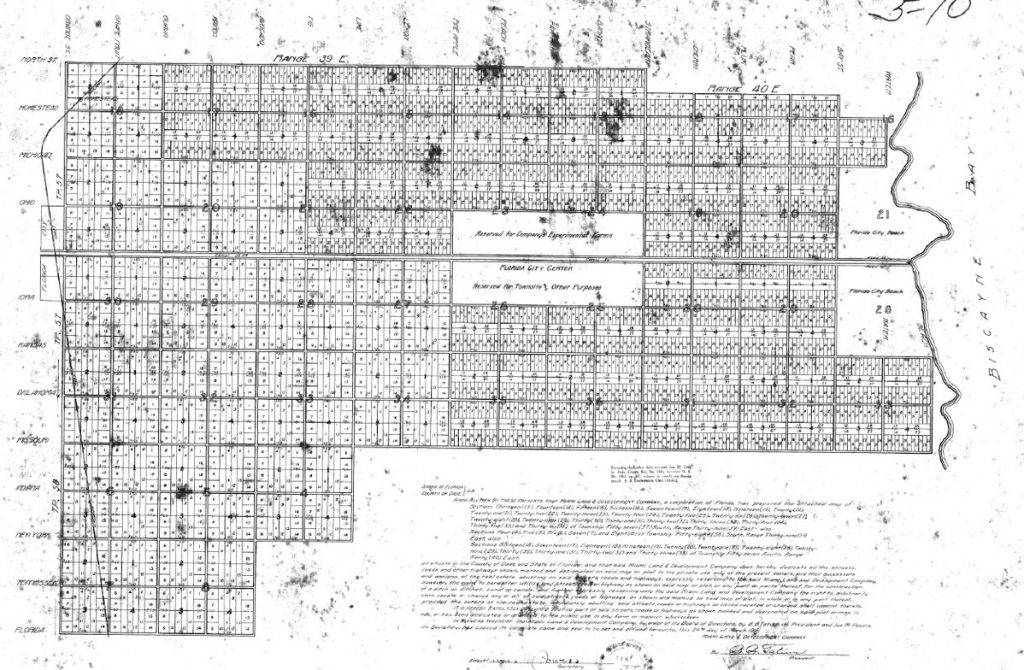
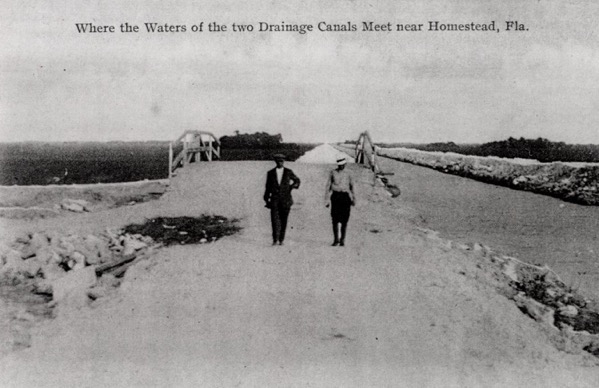
The Tatum Bros. Real Estate & Investment Co., which founded the town of Detroit in 1910, relentlessly promoted their property as a place where buyers could become wealthy practically overnight by growing tomatoes and other vegetables. However, there was a problem with flooding. To overcome that, the Tatum brothers had canals dug to drain the land. The first canal, called the Central canal (now known as the Florida City canal), was completed in early January, 1912. Work then commenced on a north-south canal which had no name but ran parallel to S. W. 162 Avenue and connected the Central canal to the Michigan Street canal (now known as the North canal) which runs to Homestead Bayfront and Biscayne National Parks.

In addition, an area called the Terminal Basin, which ran in a north-northwest to south-southeast direction 60 feet wide and 900 feet long, was excavated south of Palm Avenue (now Palm Drive) and east of the railroad (now the busway). These projects were completed in August of 1914.115

Industrial Basin

Industrial Addition Plat

The lots fronting on the Terminal Basin provided an ideal location for businesses to be established to process and market the crops being raised on the Detroit valley land to the east. The Hardee & McFarland Company and the Simmons Packing Company erected packing houses on some of these lots.116 In them, men, women and children sorted, washed and packed the tomatoes, beans, cabbage, lettuce, beans and squash being grown in the fields for transport by rail and water to markets further north. Small boats regularly plied the waters of the canal,117 taking vegetables to markets in Miami. One company, the Biscayne Transportation Co., offered a rate of “.45 per crate of vegetables from Florida City to New York, Philadelphia, Baltimore and other northern ports.” Cabbage could be shipped for $9 per ton. The cabbage, when it reached New York City, commanded a price of $150 per ton.118

Ice was an essential product to keep the vegetables fresh. As early as 1903, the Florida East Coast Ice Company, owned by Henry Flagler, manufactured ice in Miami.119 After the rails reached Homestead on July 30, 1904, ice and other products became readily available. The construction of the Key West Extension, which continued the railroad through Detroit and into the Florida Keys, started in April of 1905. The ice manufacturing business was very competitive and by late 1913, there were three ice manufacturers in Miami: the Florida East Coast Ice Co., Miami Cold Storage & Ice Co., and City Ice Co.120 Perhaps because the additional freight charges to bring ice to Detroit made it too expensive, the Miami Land & Development Co., established in 1911 by the Tatums, saw a profitable business opportunity and organized the Detroit Ice, Light & Power Co. on July 20, 1914.121 An application for a corporate charter from the State of Florida was filed on October 12, 1914122 and construction of the plant got underway in early December.123 The company, which made its first ice on April 19, 1915,124 had an initial output of 15 tons of ice per day.125 By 1923, the plant was producing more than 40 tons of ice daily.126

In addition to ice, the plant also provided electricity to customers close by. The steam engine that powered the compressors for the ammonia used to manufacture ice also powered dynamos to generate direct-current electricity. No research has been done regarding the production of electricity by the Detroit Ice, Light & Power Co. so it is not known how many customers the company had. It is likely, however, that the service area was small, perhaps just to the businesses located in the area of the terminal basin. The dynamo only operated while ice was being manufactured so the availability of electricity was very limited. It was not until well after December of 1917, when Homestead’s first power plant went on-line, that residents of Florida City were able to have electric service installed in their homes and businesses.

The plant was built on lots 43 – 50 of the Industrial Addition127 and a railroad spur serving the Industrial Addition was completed in early December, 1914.128 A packing house, 70′ x 150′, leased by the Hardee & McFarland Co., was added to the ice plant on the east side, nearest the waters of the Terminal Basin.129 This packing house opened for business the week of January 25, 1915 under the management of Mr. Roberts.130 131
Ice Plant Building png file

From an article in The Tropic Magazine132

Ice Plant from the south

Detroit Ice, Light & Power Co. (left) and second packing house (right)
Courtesy of Seth Bramson

This photograph was taken from the south end of the Terminal Basin looking northeast. Between the ice plant and the packing house, box cars on the F.E.C. Railway spur can be seen. The concrete foundation for the second packing house, 72′ x 100′ and built by the Simmons Packing Co., was laid in late January of 1915.133

Ice Plant in Distance

The Detroit Ice, Light & Power Co., with its tall smokestack, in the distance
Courtesy of the Florida Pioneer Museum
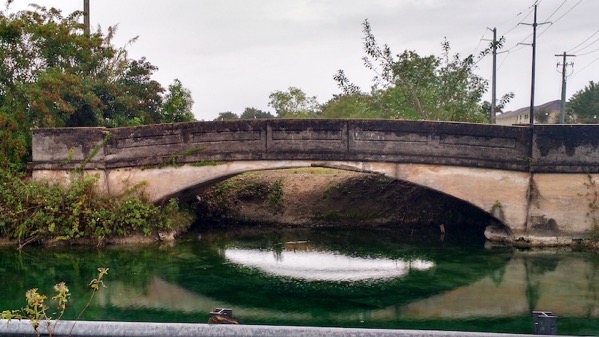
The ice plant is in the distance, a packing house is adjacent to it on the left side and the packing house in the previous photo is in the foreground on the right side. This photograph was taken from the north end of the Terminal Basin looking southwest.

The steam engine which powered the ice manufacturing machinery was fueled by wood delivered by contractors felling the virgin pine forests in the surrounding area. The DeBerry Brothers built a sawmill adjacent to the ice plant in early 1918 and supplied waste lumber to the ice company in exchange for steam from the ice plant engine to run their machinery.134

The Detroit Ice, Light & Power Co. was owned by the Miami Land & Development Co. so it is no surprise that James Powers and his son Ralph were among the initial directors of the company. Frederick W. Symmes, Marion G. Tracy and S. D. Bates were the others. Symmes was from Charleston, S.C. and was hired away from the F. E. C. Railway, where he had been an auditor based in Marathon.135 Tracy was a carpenter and contractor who had come to Miami in 1912 from the same neighborhood in Topeka, Kansas136 as Dr. John B. Tower, Orville W. Calkins, Roy D. Marsh and Hugh H. Ewing, all 1910 homesteaders in Longview, west of Detroit. Bates was the paymaster and cashier for the F. E. C. Railway in Marathon137 and was no doubt a friend of Symmes.

Frederick W. Symmes, a Spanish-American War veteran, was an insurance agent in Charleston, S. C. before he came to Miami in 1912.138 His son, Thomas H., was a physician.139 Frederick only lived in Detroit briefly before moving to Miami in 1916.140 He visited Florida City in September of that year when he was investigating the possibility of establishing another canning plant in Florida City. Edward Stiling and Walter C. Shutts, in partnership with three men who lived in Detroit, Michigan, had established the first canning plant in Detroit in 1913.141 Symmes and Irwin R. Matthews, a brother-in-law of Rev. Joseph A. Kahl, who established the South Florida Banner, Homestead’s first newspaper, had purchased a canning and pickling plant in Delray142 143 and were considering moving it to the Homestead area. After moving to Miami, Symmes continued to work for the Tatums in real estate development,144 145 was a director of the Miami Bond & Mortgage Co. (of which J. R. Tatum was president and Henry R. Pridgen secretary-treasurer)146 and was the vice-president of the Miami & Tampa Highway Co., which proposed to build a toll road to Tampa alongside the Miami-Okeechobee canal.147

Edwin Z. Duncan, elected to the Board of Directors of the Miami Land & Development Co. in January of 1916,148 was a wealthy capitalist from Oil City, Pennsylvania. Duncan had moved to Miami in May of 1914 and “purchased the Craig house at Point View,”149 a wealthy neighborhood on Brickell Avenue. He was elected president of the Detroit Ice, Light & Power Co. in early 1917150 and Bethel B. Tatum assumed the presidency of the company in January of 1918.151

Throughout all of these changes in the membership of the Board of Directors of the company, Marion G. Tracy managed the ice plant. The company moved into the Miami market in late 1917 and its name was changed to the Dade County Ice Company in early 1918.152

By the mid-1920s, the market for ice exploded, there being 14 ice companies in Miami by 1927.153 In June of 1923, the Homestead Leader reported that the capacity of the factory was being taxed by the need for ice for pineapples arriving from Cuba on “the big F.E.C. ferries.”154 Tracy, who also owned the Tracy Lumber Co. in Florida City, purchased the Dade County Ice Co. in 1924 and then built a plant at Douglas Road and the F. E. C. Railway tracks.155 The Homestead Enterprise reported on April 17, 1925 that Tracy had purchased a plot of land near Avocado drive and the Dixie Highway, where he would build an ice plant with a capacity of 65 tons a day.156 The Florida City plant was still producing ice in November of 1925, as G. A. Kass had recently arrived “to take up the duties as engineer at the Tracy company ice plant in Florida City.”157

In March of 1926 Tracy sold the company to the South Florida Ice Co. for $700,000 ($9.9 million in 2018 dollars). The Florida City plant had a capacity of 30 tons per day, the Homestead plant 60 tons and the Coconut Grove plant 80 tons.158 The South Florida Ice Co. changed its name of the General Public Utilities Co. (GPU) a few days later and was authorized by the state of Florida to increase its capital stock to 600,000 shares, thus increasing its ability to acquire more companies.159 Between April and June of 1926, it purchased the Royal Palm Ice Co., founded in 1921 in Miami.160 161 It was located at the corner of N.W. 4th St. and 1st Ct. in Miami.162 In July the GPU purchased the ice business of the Redland Ice, Light & Power Co., located in Naranja.163

The General Public Utilities Co. was a holding company – it retained the company names and officers of all of its acquisitions. Marion G. Tracy, as president and general manager and his son Marion E., as secretary-treasurer, continued to be listed as the officers of the Tracy Ice Co.164 The Royal Palm Ice Co. plant in Homestead, located on lots 18 and 19 of block 3 of the plat of Seminole Heights, was listed as delinquent on the property taxes for its Homestead plant, located across the highway from what is now Seminole Wayside Park, in the July 30, 1932 issue of the Miami Daily News.

Seminole Heights

Plat of Seminole Heights

Tracy retired from his business in the early 1930s and moved to Ocala in about 1935. He didn’t stay there long before moving to Sanford in mid-1937.165 Shortly after moving there, Marion G. Tracy died at the age of 60 on March 14, 1938 and is buried in the Evergreen Municipal Cemetery.

The Royal Palm Ice Co. in Homestead continued to produce ice for refrigerated box cars well into the 1950s. It is unknown when the plant in Florida City closed but the terminal basin was still in existence into the late 1960s. The basin and the portion of the Florida City canal west of Krome Avenue that led to it was filled in and is now part of the property that is the location of the Strano Brothers packing house complex. You can see the outline of the basin and canal on the property by clicking on this link and entering the address 75 W. Palm Dr.
_____________________________________________________________
Posted in Business, Florida City, Homestead, Naranja, Newspapers, Pioneers | Tagged Detroit, Detroit Ice Plant, Florida City, Florida East Coast Railway | 7 Replies

Post navigation

← Older posts
Newer posts →

Subscribe to Articles

Subscribe

* indicates required

/* real people should not fill this in and expect good things – do not remove this or risk form bot signups */

Intuit Mailchimp

Quotes about History

The challenge of history is to recover the past and introduce it to the present.David Thelen
… (next quote)

Recent Posts

  • The Sawmills of South Dade – Chapter 3
  • The Sawmills of South Dade – Chapter 2
  • The Sawmills of South Dade – Chapter 1
  • Joe Frank Lofton
  • Andrew J. Poplin
  • John S. Frederick
  • The Cedars
  • William S. Burkhart
  • The Story of Franjo Road
  • Kendal Grove
  • Frederic M. Vermilye
  • The House That McNeill Built
  • The Story of Epmore Drive
  • William C. Norwood
  • William A. King

Archives

Categories

Links

African-American History
  • African-American
  • Dr. Marvin Dunn
  • Low Country Africana
Agriculture
  • Florida State Horticultural Society
  • USDA Search Engine
Genealogy
  • Dade County Marriages 1905-1911
  • Palm Beach County Marriages 1909-1913
Government Resources
  • Early Automobile Registrations
  • Florida Railroad Commission Reports
  • Florida State Library
  • Historical County Boundaries
  • IIF Minutes
  • USGS Topo Maps of S. Dade
Homesteading Records
  • BLM Homesteading Records
  • BLM Tract Books at Family Search
  • Miami-Dade Clerk of Courts
  • Township Range Locator
Magazines
  • Tequesta Magazine
  • The Tropic Magazine
Miscellaneous
  • History of Florida, 1923
  • Marion Post Wolcott WPA Photographs
  • Upper Keys Historical Society
South Dade Resources
  • Buncombe County, NC Deeds
  • Hopkins Plat Book – 1957
  • Polk’s Directory of Homestead – 1918
  • Sanborn Fire Map of Homestead – 1920
University Resources
  • Aerial Photographs of South Dade – 1938
  • Florida Historical Quarterly
  • PALMM
  • UF Digital Library
  • UM Special Collections
©2026 - Historic South Dade - Weaver Xtreme Theme
↑